
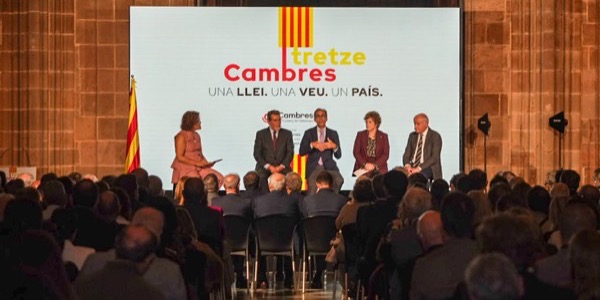
The celebration of the law’s approval, held at the Llotja de Mar, brought together institutional and business representatives to reflect on the role of the chambers and the challenges of the new stage.
On 27 October the Llotja de Mar hosted the event celebrating the approval of the new Chambers of Commerce Law, a milestone that opens a new stage for these institutions. Under the motto “Thirteen chambers. One law. One voice. One country”, the gathering brought together representatives of the thirteen Catalan chambers and authorities such as the President of the Parliament, Josep Rull, and the ministers Alícia Romero and Miquel Sàmper.
Beyond the celebration, the event addressed the role of the chambers in the Catalan economy and the challenges they will face in this new stage: strengthening business representation, maintaining effective dialogue with the administrations and continuing to contribute to the country’s economic development.
During the main conversation, Ricard Nel·lo, lawyer and drafter of the law, focused on the institutional recognition of the chambers and the strengthening of their public functions, purposes of representation and participation. The new legal framework must provide greater legal certainty and tools so that they can continue to take part in the public policies that affect business activity.
For Pau Relat, chairman of the board of Fira de Barcelona, one of the distinguishing features of the chambers is their ability to represent all companies, from the self-employed to large corporations. This representativeness gives them a unique position to foster institutional stability, build consensus and drive projects that help strengthen the business fabric.
Proximity to companies was also the focus of the address by Sílvia Gratacós, president of the Manresa Chamber, who highlighted the support the institution offers to companies in the Bages in areas such as sustainability, the energy transition and internationalisation. She also defended the role of chamber plenary sessions as spaces for debate on issues affecting the territory, such as infrastructure, and for conveying these needs to the administrations. In this regard, she also pointed to the importance of strengthening the link between vocational training and companies’ needs.
From Girona, the Chamber’s president, Jaume Fàbrega, pointed to the challenge of reaching the whole territory with the same quality of service and argued for the need to work together, reach agreements and strengthen the role of the chambers in promoting the Catalan economy and language.
In the closing remarks, the president of the General Council of Chambers, Josep Santacreu, acknowledged the work of the thirteen chambers and of the teams that have made their track record possible. He also appealed to the responsibility that comes with the trust placed in these institutions and to the need to harness the momentum of the new law to go further in the commitment to the country’s economy.
The ideas shared during the event pointed in the same direction: the value of the chambers lies not only in their institutional recognition, but also in their ability to be useful to companies, build consensus and maintain long-term public-private collaboration. The challenge will be to turn the new framework into an effective tool at the service of these functions.
This reflection also concerns industrial estates, where issues such as infrastructure, services, sustainability and competitiveness call for a shared vision and effective dialogue with the administrations. Chambers of commerce and estate associations know these needs from complementary perspectives. UPIC, which brings both realities together in its membership, helps connect them and give a collective dimension to the sector’s challenges.
UPIC connects industrial estate associations, gives a collective dimension to the challenges they share and strengthens their dialogue with institutions. Because improving industrial estates requires adding voices, building alliances and turning shared needs into concrete answers.