
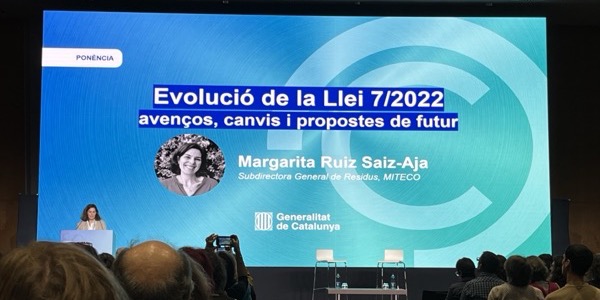
UPIC attended the III Catalunya Circular Congress on 29 October, held at the Barcelona International Convention Centre (CCIB), a meeting that brought together representatives from different sectors to share experiences and address the challenges and opportunities of the circular economy.
Among the issues discussed on the second day, the evolution of the European regulatory framework stood out. In the talk “Evolution of Law 7/2022: progress, changes and proposals for the future”, Margarita Ruiz Saiz-Aja, Deputy Director General for Waste at the Ministry for the Ecological Transition and the Demographic Challenge, addressed the future outlook for waste regulation. During the session, it was announced that the European Commission plans to publish the European Circular Economy Act on 18 November. According to the information presented, the initiative could take the form of a regulation rather than a directive, an option that would make direct application in the member states easier. The publication of the proposal will make it possible to better understand its content and assess its implications for companies.
The day also addressed the role of clusters in this transformation. Alberto Pezzi, senior manager at ACCIÓ Clusters, stressed that circularity is not only a technological challenge but also one of coordination. Moving forward requires connecting capabilities, sharing knowledge and identifying opportunities for collaboration between companies and sectors. The presence of Catalan clusters at the congress reflects the cross-cutting nature of this challenge.
This collaborative dimension is also relevant for industrial estates, where proximity between companies can facilitate the identification of synergies, industrial symbiosis and the shared use of resources. In the energy field, the same logic can open up opportunities to explore joint projects, such as industrial energy communities. In all these cases, coordination between companies is an important factor in identifying common needs and turning opportunities into shared initiatives.
The day thus offered complementary perspectives on regulatory changes and business cooperation that can help move towards more circular production models. These are issues that also concern industrial estates, both for the collaboration opportunities they offer and for their potential to drive shared initiatives among the companies located there.